Updated October 2026 · 9 min read · for students, builders & business owners
Intelligent agents in AI: definition, PEAS, 5 types and 10 examples
Most explanations of intelligent agents stop at the textbook. This one explains the theory in plain English, lets you build a PEAS description with one click, and then shows how the exact same thinking becomes an AI agent a business pays for every month.

Jarvy, your teacher on this page. Jarvy teaches people how to make money with AI by building and selling AI agents to real businesses.
An intelligent agent is anything that perceives its environment through sensors and acts on it through actuators, choosing the action that is expected to do best on a performance measure. That is the classic definition from Russell & Norvig's Artificial Intelligence: A Modern Approach. A thermostat is a very simple agent. A self-driving car is a very complex one. An AI receptionist that answers messages and books appointments sits in between.
How an intelligent agent works: sense, think, act
Every agent runs the same loop, again and again. The difference between a thermostat and a self-driving car is how smart the middle step is.
1. Sensors
Take in percepts: a camera frame, a temperature, a new WhatsApp message.
2. Agent program
Maps what it perceived (plus memory, goals) to the next action.
3. Actuators
Do something: brake, move a robot arm, send a reply, book a slot.
4. Environment
Changes because of the action, which creates new percepts.
Agent = architecture (the body: hardware, servers, tools) + program (the logic that picks the action)
PEAS: describe any agent in 4 lines
Before anyone builds an agent, they write down its Performance measure, Environment, Actuators and Sensors. Pick an agent to see its PEAS. Two are textbook classics, two are agents businesses pay for.
Safe, fast, legal trip; passenger comfort
Roads, other traffic, pedestrians, weather
Steering, accelerator, brake, signals, horn
Cameras, lidar, radar, GPS, speedometer
The 5 types of intelligent agents
Each type remembers more and looks further ahead than the one before. Full explanation with diagrams: types of AI agents.
Simple reflex
If condition, then action. No memory.
ThermostatModel-based
Keeps an internal picture of what it can't see right now.
Robot vacuumGoal-based
Plans a sequence of actions to reach a goal.
Route plannerUtility-based
Weighs options and picks the best trade-off, not just any goal.
Self-driving carLearning
Gets better from feedback on its own results.
Spam filterQuick check: which type is it?
A heater switches on whenever the room drops below 19 °C.
An app finds a route from your home to the airport.
A booking agent fills the calendar while weighing travel time, job value and the customer's preferred slot.
You can read agents like a builder. The free training shows how to turn that into an agent a business pays for.
Watch the free training →Environment properties: why some agents are much harder to build
The textbook sorts every environment on 6 scales. Compare a chess engine with an AI receptionist.
| Property | Chess (with a clock) | AI receptionist |
|---|---|---|
| Observable | Fully: the whole board is visible | Partially: it can't see what the customer really means |
| Deterministic | Yes: a move has a known result | No (stochastic): people answer unpredictably |
| Episodic or sequential | Sequential | Sequential: one reply shapes the next |
| Static or dynamic | Semi-dynamic: the clock runs | Dynamic: new messages arrive while it works |
| Discrete or continuous | Discrete | Discrete: messages and time slots |
| Single or multi-agent | Multi-agent (opponent) | Multi-agent (customers, staff, other tools) |
This is why business agents need a human handoff: in a partially observable, stochastic environment the agent will meet situations it can't resolve. Systems where several agents work together are covered in multi-agent systems. The modern, business-ready version of these ideas is called agentic AI.
FREEGo from theory to a working agent with Jarvy
Reading is step one. Jarvy's free course turns it into action: every lesson ends with one concrete task.
- Pick one boring task to automate
- Build your first agent, no code
- Price it: setup + monthly fee
- Run a paid 14-day pilot
10 examples of intelligent agents in AI
From the textbook to the ones on a business's monthly invoice.
| Agent | Type | Sensors | Actuators |
|---|---|---|---|
| Thermostat | Simple reflex | Thermometer | Heater switch |
| Spam filter | Learning | Incoming email | Move to spam / inbox |
| Chess engine | Utility-based | Board position | Next move |
| Robot vacuum | Model-based | Bump, dirt and cliff sensors | Wheels, brushes, suction |
| Self-driving car | Utility-based | Cameras, lidar, GPS | Steering, brake, accelerator |
| Recommendation engine | Learning | Clicks, views, purchases | Ranked list of products |
| AI receptionist | Goal-based | WhatsApp, web chat, calendar | Replies, bookings, handoff |
| Voice agent | Goal-based | Phone audio (speech-to-text) | Spoken answer, booking |
| Lead follow-up agent | Goal-based | Form entries, missed calls | Texts, CRM updates |
| Multi-agent team | Several types | Each agent's own inputs | Hand work to each other |
The last four are what an AI agency sells. 20 more, sorted by industry: AI agent examples.
From textbook agent to an agent a business pays for
The difference between a homework agent and a paid one is not the AI model. It is the performance measure. A business doesn't pay for "an agent". It pays for one number that improves: missed calls answered, leads replied to within a minute, appointments booked.
- P first: pick one task a business loses money on and one number to improve.
- E, A, S: list the channels it reads (sensors) and the tools it may use (actuators): calendar, CRM, WhatsApp.
- Build it with no code, add a human handoff, and run a short paid pilot.
- Charge a setup fee plus a monthly retainer to keep it running and improving.
What an agent earns depends on the niche, your pricing and how many clients you sign. These steps are a method, not a promise of income.
Watch Jarvy do this step by step →Go deeper: what are AI agents · how to build AI agents · what is an AI agency · AI agent pricing
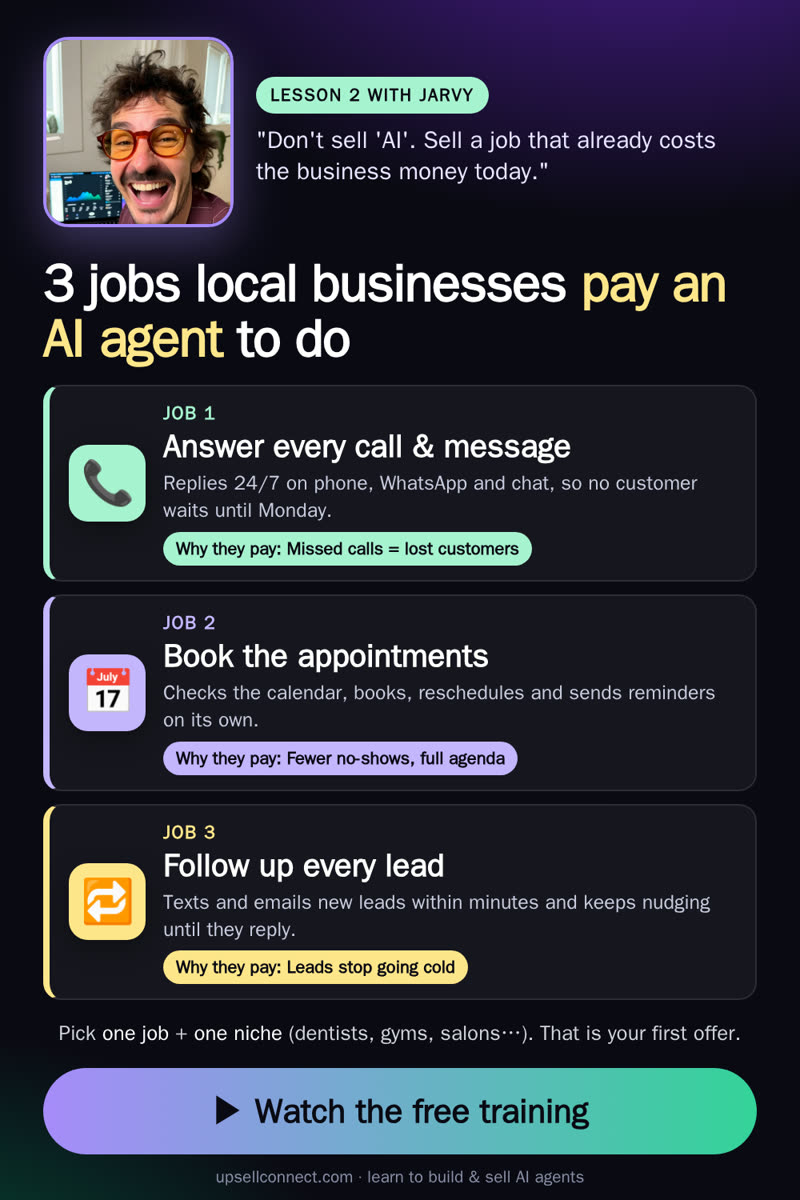 From lesson 2 of the free course
Watch Jarvy build an intelligent agent that does real work for a business
Free training, in English, about 45–60 minutes: an agent that takes real actions, how to price it as setup + retainer, and how to find the first clients. No coding background needed.
Watch the free training →Free · no credit card
Questions
What is an intelligent agent in AI?
Anything that perceives its environment through sensors and acts on it through actuators, choosing the action that is expected to do best on its performance measure. A thermostat, a chess engine, a robot vacuum and an AI receptionist are all agents.
What is PEAS in artificial intelligence?
Performance measure, Environment, Actuators and Sensors: the standard way to describe an agent's task before you design it. Try the PEAS builder above.
What are the 5 types of intelligent agents?
Simple reflex, model-based reflex, goal-based, utility-based and learning agents. Each keeps more information about the world and plans further ahead than the one before.
What is a rational agent?
An agent that picks the action expected to maximise its performance measure, given what it has perceived and knows. Rational does not mean all-knowing; it means doing the best with the information available.
Is ChatGPT an intelligent agent?
A chat model on its own mostly answers text with text. It becomes an agent when it is connected to tools and allowed to act, such as booking an appointment, sending a message or updating a CRM, in a loop with a goal.