Updated October 2026 · 8 min read · for beginners, builders & business owners
What is agentic AI? Definition, examples and how it differs from generative AI
Everyone says "agentic" now. Here is what it actually means, shown with a side-by-side comparison you can click, the 5 levels of AI autonomy, and the business tasks where agentic AI is already something companies pay for every month.

Jarvy, your teacher on this page. Jarvy teaches people how to make money with AI by building and selling AI agents to real businesses.
Agentic AI is AI that can pursue a goal on its own: it plans the steps, uses tools (calendar, email, CRM, browser), checks the result and tries again, and asks a human only when it is unsure. Generative AI makes something when you ask. Agentic AI gets a job done. Gartner listed agentic AI as its number one strategic technology trend for 2025, and it has been the main AI topic for businesses since.
How agentic AI works: the agentic loop
A language model is the brain. What makes it agentic is the loop around it: it keeps going until the goal is reached.
1. Goal
"Book every missed caller into a free slot."
2. Plan
Breaks the goal into steps and decides what to do first.
3. Act
Uses tools: sends a text, reads the calendar, updates the CRM.
4. Check
Looks at the result. Did the customer reply? Is the slot still free?
5. Learn
Remembers what happened and adjusts the next step.
Agentic AI = model + goal + tools + memory + a loop (with a human handoff)
Generative AI vs agentic AI: the same task, side by side
Pick a task. Generative AI gives you something to use. Agentic AI does the work. Two of these are agents local businesses pay for.
Writes a friendly reply you could send to the patient who called. You still have to read it, open the calendar and book the slot yourself.
Sees the missed call, texts the patient, checks free slots in the calendar, books the appointment, sends a reminder and hands off to staff if the question is medical.
Detect missed call → Text the patient → Check calendar → Book + remind
This is the kind of agent a dental clinic pays for every month: missed calls are missed patients.
See how an agent like this is built and sold →| Generative AI | AI agent | Agentic AI | |
|---|---|---|---|
| What it is | A model that creates content | One system that perceives and acts | The approach of building AI that acts autonomously towards goals |
| Starts when | You write a prompt | A trigger or a request | A goal is set, then it keeps going |
| Uses tools | No (or one at a time) | Yes | Yes, several, chosen by itself |
| Multi-step | No | Sometimes | Yes: plans, acts, checks, repeats |
| Example | Writing an email | A booking bot | A team of agents running lead intake to booked visit |
The textbook view of agents (sensors, actuators, PEAS) is in intelligent agents in AI. Where rules-based tools stop and agents start: AI agents vs automation.
The 5 levels of AI autonomy
"Agentic" is not on or off. It is a ladder. Tap a level to see what the AI does and what is left for you.
Level 3 · Agentic workflow
Gets a goal, plans the steps, uses several tools, checks its own work and asks a human only when unsure.
You set goals and approve edge cases.Level 3 is where most paid business agents sit today: useful, reliable enough, with a human safety net.
Watch Jarvy build a level 3 agent →Level 4 is covered in depth in multi-agent systems.
The 4 agentic design patterns
AI researcher Andrew Ng popularised the term "agentic workflows" and grouped them into four patterns. Almost every agentic system combines them.
Reflection
The AI reviews its own output and improves it before it acts.
Checks a reply before sendingTool use
It calls tools: search, calendar, CRM, payments, code.
Books a real slotPlanning
It splits a goal into steps and decides the order.
Intake, quote, bookingMulti-agent
Several agents with roles work together and hand off.
Sales agent + support agentWhich frameworks people use to build these: AI agent frameworks. Step-by-step: how to build AI agents.
Quick check: agentic or not?
You ask a chatbot to write an Instagram caption and copy it yourself.
An AI notices a missed call, texts the caller, finds a free slot and books the appointment.
A rule sends the same "thanks for your order" email every time someone buys.
An AI researches 20 competitors, notices two websites failed to load, retries them and writes a report.
You can spot agentic AI like a builder. The free training shows how to build one a business pays for.
Watch the free training →FREEBuild your first agentic workflow with Jarvy
Reading is step one. Jarvy's free course turns it into action: every lesson ends with one concrete task.
- Pick one boring task to automate
- Build your first agent, no code
- Price it: setup + monthly fee
- Run a paid 14-day pilot
8 examples of agentic AI in business
The first four are what small AI agencies sell to local businesses. The rest are bigger company use cases.
| Agentic workflow | Goal | Tools it uses |
|---|---|---|
| AI receptionist | Answer and book every enquiry | WhatsApp, web chat, calendar |
| Missed-call text-back | No lost callers | Phone system, SMS, calendar |
| Lead follow-up agent | Reply to every lead within a minute | Forms, SMS, CRM |
| Review and reactivation agent | More reviews, more repeat visits | CRM, WhatsApp, review links |
| Customer support agent | Solve tickets, escalate the hard ones | Help desk, knowledge base, order system |
| Research agent | A sourced report on a topic | Web search, browser, documents |
| Coding agent | Fix a bug or ship a feature | Code editor, terminal, tests |
| Finance back-office agent | Invoices matched and chased | Inbox, accounting software |
20 more, sorted by industry: AI agent examples. The basics of agents themselves: what are AI agents.
Agentic AI on the phone: AI voice agents answer calls, book appointments and hand over to staff.
How people make money with agentic AI
Big companies build agentic AI in-house. Local businesses can't, and they have the same problems: missed calls, slow replies, no-shows. That gap is the opportunity behind an AI agency.
- Pick one costly task in one niche, like missed calls at dental clinics.
- Build a level 3 agentic workflow with no-code tools, with a human handoff.
- Run a short paid pilot and measure one number, like bookings.
- Charge a setup fee plus a monthly retainer to keep it running and improving. See AI agent pricing.
What you earn depends on your niche, your prices and how many clients you sign. These steps are a method, not a promise of income.
Watch Jarvy do this step by step →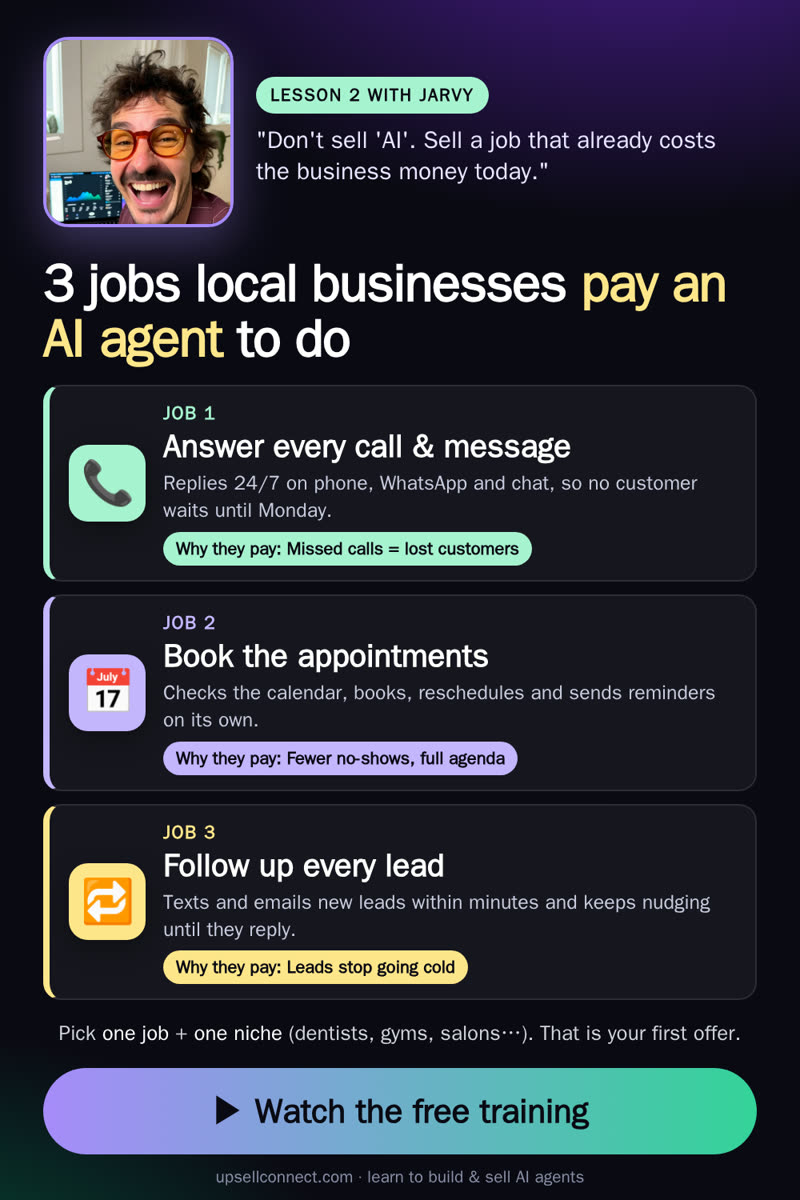 From lesson 2 of the free course
Watch Jarvy build an agentic workflow that does real work for a business
Free training, in English, about 45–60 minutes: an agent that takes real actions, how to price it as setup + retainer, and how to find the first clients. No coding background needed.
Watch the free training →Free · no credit card
Questions
What is agentic AI in simple terms?
Agentic AI is AI that works towards a goal on its own: it plans the steps, uses tools such as a calendar, email or a CRM, checks the result and adjusts, with a human stepping in only when needed. Generative AI makes content; agentic AI gets a task done.
What is the difference between agentic AI and generative AI?
Generative AI creates text, images or code when you prompt it, and then stops. Agentic AI uses a generative model as its brain but adds goals, memory, tools and a loop, so it can take actions and finish multi-step work without a prompt for every step.
What is the difference between agentic AI and AI agents?
An AI agent is one system that perceives and acts. Agentic AI is the broader approach: designing AI so it behaves autonomously, from a single agent with tools to a team of agents working together in a multi-agent system.
Is ChatGPT agentic AI?
A plain chat conversation is generative AI: it answers and waits. When a model is connected to tools and allowed to take actions in a loop towards a goal, for example browsing, booking or sending messages, it is being used agentically.
Can you make money with agentic AI?
Yes, mainly by building agentic workflows for businesses that lose money on slow, repetitive tasks, such as missed calls or slow lead follow-up, and charging a setup fee plus a monthly retainer. Results depend on your niche, pricing and how many clients you sign; this is a method, not a promise of income.